Professional Certification Path

AI + ML Masters Program
Mastery Program.

A rigorous, 16-week masters-level engineering program designed for data scientists, ML engineers, and AI architects. Deeply covers mathematical foundations, classical machine learning, PyTorch deep learning, Transformer architectures, Parameter-Efficient Fine-Tuning (LoRA/QLoRA), Enterprise RAG, Autonomous Agents, and production MLOps deployment.

Level: Masters / Advanced Professional Track
Job Ready
Self-Paced
AI + ML Masters Program
Interactive Audio-Visual Masterclass & Sandbox

AI & Deep Learning Architecture Sandbox

Simulate backprop loss curves (MLP, ResNet, CNN, Transformer), compute cosine similarity matrices, calculate exact LoRA/QLoRA VRAM footprints, and benchmark MLOps throughput. Includes AI Neural voiceovers for each lesson so you can master concepts visually and audibly without boring video delays.
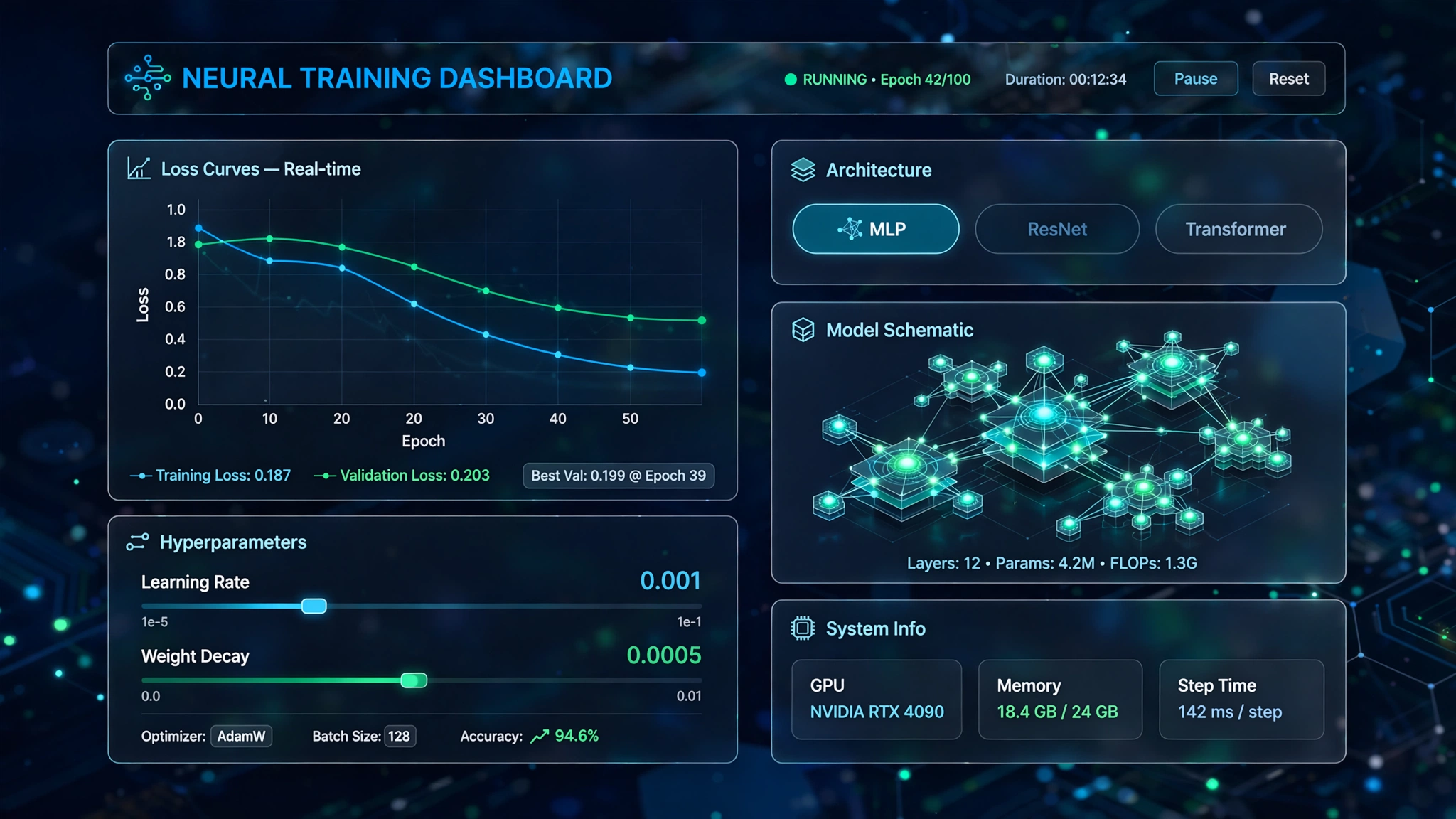
AI & Deep Learning Architecture Sandbox

Course Curriculum & Hands-on Labs

16 Modules • 32 In-Depth Lessons • 16 Practical Lab Assignments • 32 Quizzes

Phase 1: Deep Learning Foundations
Weekly Engineering Competency Outcome: Master matrix decomposition (SVD, Eigenvalues), high-dimensional geometry, tensor rank approximations, and GPU memory layouts.
Structured Lessons & Topics
Matrix Decompositions: SVD, Eigenvalues & Tensor Geometries on GPU
Duration: 50 mins Quiz Evaluation Included
Text
High-Dimensional Semantic Geometry, Dot Products & Cosine Metric Spaces
Duration: 45 mins Quiz Evaluation Included
Lab
Weekly Hands-On Project Assignment
Graded Lab

Lab Assignment 1: SVD Weight Compression Engine for Linear Layers

Objective: Build a PyTorch module that factorizes a large linear layer (W: 4096 x 4096) into low-rank matrices A and B using truncated SVD, and benchmark accuracy vs parameter savings.

Task Instructions: 1. Initialize a linear layer with random Gaussian weights representing a pre-trained layer. 2. Compute full SVD. 3. Truncate to rank r = [16, 32, 64, 128]. 4. Measure parameter reduction ratio, reconstruction error, and FLOP savings per forward pass.
Deliverables: A single Python script `svd_compression_lab.py` containing the `LowRankLinear` module and benchmark graphs.
Grading Rubric: 40% functional correctness, 30% numerical accuracy against baseline SVD, 30% benchmarks.
Weekly Engineering Competency Outcome: Eliminate Python interpreter bottlenecks through SIMD vectorization, memory-aligned strides, contiguous buffers, and high-throughput batching.
Structured Lessons & Topics
Vectorized SIMD Broadcasting, Memory Strides & Cache Alignment
Duration: 45 mins Quiz Evaluation Included
Text
Memory-Mapped Arrays (mmap) & Zero-Copy Batch Data Ingestion
Duration: 50 mins Quiz Evaluation Included
Lab
Weekly Hands-On Project Assignment
Graded Lab

Lab Assignment 2: Zero-Copy Vectorized Batch Ingestion Engine

Objective: Build a high-performance Python data loader using `np.memmap` and vectorized NumPy broadcasting that yields batches of 1024 token sequences with under 2 milliseconds latency per batch.

Task Instructions: 1. Generate a binary token file of 500,000 sequences (sequence length 128). 2. Implement an asynchronous memory-mapped batch generator. 3. Apply dynamic sequence padding and attention mask generation purely through vectorized broadcasting without loops.
Deliverables: `data_ingest_engine.py` with benchmark script verifying batch latency under 2ms.
Grading Rubric: 50% throughput/latency, 30% zero-copy compliance, 20% documentation.
Weekly Engineering Competency Outcome: Derive backpropagation via the multivariable chain rule, implement reverse topological sorting, and build an autograd engine from scratch.
Structured Lessons & Topics
Multivariable Chain Rule, Vector-Jacobian Products & Computational Graphs
Duration: 55 mins Quiz Evaluation Included
Text
Building MicroGrad from Scratch: Value Nodes, Adjoints & Topological Sort
Duration: 60 mins Quiz Evaluation Included
Lab
Weekly Hands-On Project Assignment
Graded Lab

Lab Assignment 3: Extend Scalar Autograd Engine to 2-Layer Neural Net

Objective: Extend the `Value` class with `relu()`, `tanh()`, and `pow()` methods, build a Multi-Layer Perceptron (MLP) consisting of `Neuron` and `Layer` classes, and train it to fit a non-linear XOR boundary.

Task Instructions: 1. Implement `relu()` with backward derivative $(data > 0)$. 2. Build `MLP(nin=2, nouts=[16, 16, 1])`. 3. Run 100 epochs of gradient descent with learning rate 0.05 on XOR dataset. 4. Verify training loss drops below 0.01.
Deliverables: Self-contained Python script `custom_autograd_xor.py` demonstrating convergence.
Grading Rubric: 40% mathematical correctness of derivatives, 40% XOR convergence, 20% clean OOP structure.
Weekly Engineering Competency Outcome: Derive Cross-Entropy from Maximum Likelihood Estimation, implement custom loss functions, and master L1/L2 weight decay and label smoothing.
Structured Lessons & Topics
Maximum Likelihood Estimation (MLE), NLL & Cross-Entropy Derivation
Duration: 45 mins Quiz Evaluation Included
Text
L1/L2 Weight Decay, Dropout Mechanics & Label Smoothing
Duration: 50 mins Quiz Evaluation Included
Lab
Weekly Hands-On Project Assignment
Graded Lab

Lab Assignment 4: Custom Focal Loss & Label Smoothing Implementation

Objective: Implement Lin et al.'s Focal Loss $(\text{FL}(p_t) = -\alpha_t (1 - p_t)^\gamma \log(p_t))$ in PyTorch with LogSumExp numerical stability, and train a classifier on an imbalanced dataset (95% class 0, 5% class 1).

Task Instructions: 1. Write `FocalLoss(nn.Module)` with parameters $\gamma=2.0$ and $\alpha=0.25$. 2. Compare against standard CrossEntropyLoss on the imbalanced dataset. 3. Graph precision-recall curves showing minority class recovery.
Deliverables: Python file `focal_loss_benchmark.py` and saved PR-curve plot.
Grading Rubric: 40% numerical stability, 30% minority class PR-AUC improvement, 30% code elegance.
Phase 2: Sequence & Attention Mechanics
Weekly Engineering Competency Outcome: Understand recurrent hidden state propagation, vanishing/exploding gradients, gating mechanisms (LSTM & GRU), and bidirectional representations.
Structured Lessons & Topics
Vanishing & Exploding Gradients in Recurrent State Transitions
Duration: 50 mins Quiz Evaluation Included
Text
LSTM & GRU Gating Mechanics: Cell State, Forget, Input & Output Gates
Duration: 55 mins Quiz Evaluation Included
Lab
Weekly Hands-On Project Assignment
Graded Lab

Lab Assignment 5: Character-Level Language Model with Custom LSTM & Gradient Clipping

Objective: Build a character-level sequence predictor from scratch using your `CustomLSTMCell`, implement global norm gradient clipping (`torch.nn.utils.clip_grad_norm_`), and generate Shakespearean text snippets.

Task Instructions: 1. Tokenize a text file into character vocab. 2. Implement truncated BPTT with sequence length 64. 3. Train for 20 epochs with Adam. 4. Implement temperature-scaled sampling for inference.
Deliverables: Python file `char_lstm_model.py` and sample text generation outputs at temperatures T=[0.2, 0.7, 1.2].
Grading Rubric: 40% loss convergence, 30% temperature sampling correctness, 30% clean fused gate implementation.
Weekly Engineering Competency Outcome: Derive Scaled Dot-Product Attention, prove the variance scaling factor $\sqrt{d_k}$, and implement Multi-Head Attention from scratch.
Structured Lessons & Topics
Scaled Dot-Product Attention: Mathematical Derivation & The Sqrt(d_k) Factor
Duration: 55 mins Quiz Evaluation Included
Text
Multi-Head Attention (MHA) Implementation & Quadratic Complexity Analysis
Duration: 60 mins Quiz Evaluation Included
Lab
Weekly Hands-On Project Assignment
Graded Lab

Lab Assignment 6: Multi-Head Causal Self-Attention with KV-Caching

Objective: Build a modular `CausalSelfAttention` class supporting both full training parallel forward pass and single-token auto-regressive generation with an incremental Key-Value (KV) cache.

Task Instructions: 1. Implement triangular causal lower mask. 2. Implement incremental KV-cache in PyTorch that stores past $K$ and $V$ tensors and concatenates the new token vector. 3. Benchmark generation speed: with KV-cache vs without KV-cache for 128 generated tokens.
Deliverables: Python script `causal_attention_kv_cache.py` with benchmark graphs.
Grading Rubric: 40% KV-cache speedup verification, 40% causal masking correctness, 20% clean modular structure.
Weekly Engineering Competency Outcome: Master state-of-the-art open-source LLM architectures: RMSNorm, SwiGLU activations, Rotary Position Embeddings (RoPE), and Grouped-Query Attention (GQA).
Structured Lessons & Topics
Rotary Position Embedding (RoPE) Mathematical Derivation
Duration: 55 mins Quiz Evaluation Included
Text
RMSNorm, SwiGLU MLP & Grouped-Query Attention (GQA)
Duration: 55 mins Quiz Evaluation Included
Lab
Weekly Hands-On Project Assignment
Graded Lab

Lab Assignment 7: Assemble a 125M LLaMA-3 Style Transformer Decoder

Objective: Build and initialize a complete modern decoder architecture integrating RMSNorm, RoPE, SwiGLU, and Grouped-Query Attention (GQA) in PyTorch.

Task Instructions: 1. Implement `RMSNorm` with learnable scale parameter $g$. 2. Implement `RotaryEmbedding`. 3. Implement `SwiGLU` MLP. 4. Connect 6 transformer blocks with residual connections and verify parameter count.
Deliverables: Python file `llama3_decoder_from_scratch.py` with forward pass unit test.
Grading Rubric: 40% architectural accuracy, 30% RoPE relative invariance test, 30% clean code.
Weekly Engineering Competency Outcome: Master contrastive learning (InfoNCE loss), Sentence Transformers, Approximate Nearest Neighbors (HNSW, IVF-PQ), and Hybrid BM25 search.
Structured Lessons & Topics
Contrastive Learning, InfoNCE Loss & Bi-Encoder Fine-Tuning
Duration: 50 mins Quiz Evaluation Included
Text
Approximate Nearest Neighbors (HNSW Graphs, IVF-PQ) & Hybrid Search
Duration: 55 mins Quiz Evaluation Included
Lab
Weekly Hands-On Project Assignment
Graded Lab

Lab Assignment 8: Enterprise Hybrid RAG Retriever with HNSW & BM25

Objective: Build a hybrid retrieval engine in Python combining BM25 keyword matching and FAISS/Chroma HNSW vector search, fused with Reciprocal Rank Fusion (RRF).

Task Instructions: 1. Index 5,000 technical documentation chunks. 2. Implement BM25 with `rank_bm25`. 3. Index embeddings with FAISS IndexHNSWFlat. 4. Implement `reciprocal_rank_fusion(dense_ranks, bm25_ranks, k=60)`. 5. Evaluate Recall@5 on queries containing exact technical acronyms.
Deliverables: Python file `hybrid_rrf_retriever.py` with evaluation report.
Grading Rubric: 40% RRF implementation correctness, 30% hybrid recall gains over pure vector search, 30% query latency.
Phase 3: LLM Fine-Tuning & Multi-Modal
Weekly Engineering Competency Outcome: Fine-tune 70B parameter LLMs on a single GPU using Low-Rank Adaptation (LoRA), QLoRA 4-bit NormalFloat (NF4), and Hugging Face PEFT.
Structured Lessons & Topics
LoRA Theory, Rank Selection (r) & Scaling Alpha Factor (alpha/r)
Duration: 55 mins Quiz Evaluation Included
Text
QLoRA: NormalFloat4 (NF4), Double Quantization & Paged Optimizers
Duration: 60 mins Quiz Evaluation Included
Lab
Weekly Hands-On Project Assignment
Graded Lab

Lab Assignment 9: Fine-Tune LLaMA-3 8B with QLoRA NF4 on Domain Instructions

Objective: Configure and execute a QLoRA fine-tuning run on `meta-llama/Meta-Llama-3-8B` using Hugging Face `peft`, `bitsandbytes`, and `trl` SFTTrainer, targeting all linear projections (`q_proj`, `k_proj`, `v_proj`, `o_proj`, `gate_proj`, `up_proj`, `down_proj`).

Task Instructions: 1. Set 4-bit NF4 config with `BitsAndBytesConfig`. 2. Configure `LoraConfig(r=16, lora_alpha=32, lora_dropout=0.05)`. 3. Verify trainable parameter count is < 0.2% of total model. 4. Save and merge LoRA adapter with base weights.
Deliverables: Python fine-tuning script `qlora_llama3_training.py` and evaluation inference script.
Grading Rubric: 40% training script execution without OOM, 30% parameter efficiency verification, 30% clean merge logic.
Weekly Engineering Competency Outcome: Understand human preference alignment, Reinforcement Learning from Human Feedback (PPO, KL-penalties), and Direct Preference Optimization (DPO).
Structured Lessons & Topics
RLHF Foundations: Reward Modeling, PPO & KL Divergence Penalties
Duration: 55 mins Quiz Evaluation Included
Text
Direct Preference Optimization (DPO): Closed-Form Loss & Training
Duration: 55 mins Quiz Evaluation Included
Lab
Weekly Hands-On Project Assignment
Graded Lab

Lab Assignment 10: Align an LLM with Direct Preference Optimization (DPO)

Objective: Fine-tune an SFT model using the DPO loss on a dataset of chosen vs rejected technical responses with Hugging Face TRL `DPOTrainer`.

Task Instructions: 1. Format dataset with `prompt`, `chosen`, and `rejected` keys. 2. Set DPO hyperparameter $\beta=0.1$. 3. Train for 3 epochs. 4. Track log-odds margin $(\log \pi(y_w) - \log \pi(y_l))$ across steps, verifying it increases over time.
Deliverables: Python script `dpo_alignment_trainer.py` and evaluation comparison table.
Grading Rubric: 40% loss convergence, 30% margin growth verification, 30% clean data formatting.
Weekly Engineering Competency Outcome: Master multimodal representation learning: CLIP contrastive pretraining, Vision Transformers (ViT), and projection adapters (LLaVA architecture).
Structured Lessons & Topics
Contrastive Language-Image Pretraining (CLIP) & Dual-Encoder Embeddings
Duration: 50 mins Quiz Evaluation Included
Text
Vision-Language Architecture: Vision Encoder, Projector & LLM Decoder (LLaVA)
Duration: 55 mins Quiz Evaluation Included
Lab
Weekly Hands-On Project Assignment
Graded Lab

Lab Assignment 11: Zero-Shot Multimodal Document Classification & Visual Q&A

Objective: Build a zero-shot multimodal document classifier and visual Q&A engine using Hugging Face `transformers` and a lightweight VLM (e.g. `HuggingFaceM4/idefics2-8b` or `microsoft/git-base`).

Task Instructions: 1. Ingest image invoices/receipts. 2. Formulate zero-shot prompt templates for key information extraction (Vendor, Total, Date). 3. Compare latency and structured JSON output accuracy.
Deliverables: Python script `vlm_doc_extractor.py` processing 5 test document images.
Grading Rubric: 40% extraction accuracy, 30% structured JSON compliance, 30% latency profiling.
Weekly Engineering Competency Outcome: Master ReAct autonomous loops, strict schema tool use, dynamic plan correction, and enterprise Model Context Protocol (MCP) server development.
Structured Lessons & Topics
ReAct Loops: Reasoning + Acting, Tool Calling & Context Pruning
Duration: 55 mins Quiz Evaluation Included
Text
Enterprise Model Context Protocol (MCP): Architecture & Implementation
Duration: 60 mins Quiz Evaluation Included
Lab
Weekly Hands-On Project Assignment
Graded Lab

Lab Assignment 12: Build an MCP Server with SQLite Database Inspection & Safe Execution

Objective: Build a production MCP server in Python over stdio transport that exposes database querying, table introspection, and Python scratchpad sandboxing.

Task Instructions: 1. Implement JSON-RPC 2.0 protocol handler. 2. Implement `list_tools` and `call_tool`. 3. Add safety guards (block destructive `DROP/DELETE` statements). 4. Test with a client agent loop.
Deliverables: Python file `mcp_sqlite_server.py` with integration test script.
Grading Rubric: 40% JSON-RPC compliance, 30% SQL injection/mutation safety guards, 30% integration test.
Phase 4: Production MLOps & Capstone
Weekly Engineering Competency Outcome: Achieve 4x-10x higher serving throughput using PagedAttention (vLLM), continuous iteration-level batching, and TensorRT-LLM.
Structured Lessons & Topics
KV-Cache Memory Fragmentation & The PagedAttention Algorithm
Duration: 55 mins Quiz Evaluation Included
Text
Continuous Iteration-Level Batching vs. Static Batching
Duration: 55 mins Quiz Evaluation Included
Lab
Weekly Hands-On Project Assignment
Graded Lab

Lab Assignment 13: Deploy & Benchmark vLLM Server with Continuous Batching

Objective: Deploy a local vLLM serving container hosting an 8B model, configure PagedAttention block size, and execute a locust load benchmark testing P50, P95, and P99 latency under 50 concurrent virtual users.

Task Instructions: 1. Launch vLLM server: `python -m vllm.entrypoints.openai.api_server`. 2. Run concurrency benchmark script sending Poisson-distributed requests. 3. Graph throughput (tokens/sec) vs concurrency.
Deliverables: Configuration file `vllm_config.yaml` and benchmark report `vllm_benchmark_results.json`.
Grading Rubric: 40% throughput optimization, 30% latency benchmark graphs, 30% clean configuration.
Weekly Engineering Competency Outcome: Compress LLMs for production deployment using Activation-Aware Weight Quantization (AWQ), GPTQ, and compile for edge inference via GGUF and llama.cpp.
Structured Lessons & Topics
Post-Training Quantization: AWQ vs GPTQ Mathematical Comparison
Duration: 55 mins Quiz Evaluation Included
Text
GGUF Architecture & Edge Inference with llama.cpp (AVX-512 / ARM NEON)
Duration: 55 mins Quiz Evaluation Included
Lab
Weekly Hands-On Project Assignment
Graded Lab

Lab Assignment 14: Quantize an 8B Model with AutoAWQ & Benchmark PPL

Objective: Quantize a Hugging Face model using AutoAWQ to 4-bit precision, evaluate WikiText-2 perplexity degradation against FP16 baseline, and export to GGUF format for edge inference.

Task Instructions: 1. Run AutoAWQ quantization with calibration dataset. 2. Verify model size reduces from ~16GB to ~4.5GB. 3. Measure tokens/sec speedup on GPU.
Deliverables: Quantization script `run_awq_quant.py` and perplexity benchmark log.
Grading Rubric: 40% size reduction verification, 30% perplexity preservation, 30% clean export.
Weekly Engineering Competency Outcome: Secure production AI pipelines against prompt injection, jailbreaking, data poisoning, and deploy programmable semantic guardrails (Llama Guard, NeMo).
Structured Lessons & Topics
Adversarial Attack Vectors: Prompt Injections, Jailbreaking & Data Poisoning
Duration: 55 mins Quiz Evaluation Included
Text
Multi-Layered AI Defense: Semantic Guardrails, Output Filtering & Llama Guard
Duration: 55 mins Quiz Evaluation Included
Lab
Weekly Hands-On Project Assignment
Graded Lab

Lab Assignment 15: Implement a Multi-Layered AI Security & Guardrail Gateway

Objective: Build an asynchronous FastAPI security gateway that intercepts incoming prompts, evaluates them against safety categories, redacts PII with Presidio, and blocks indirect injections.

Task Instructions: 1. Implement regex and semantic injection filter. 2. Implement automated PII anonymization. 3. Integrate simulated Llama Guard classification. 4. Return standard HTTP 400 with structured violation metadata upon breach.
Deliverables: Python file `ai_guardrail_gateway.py` with 10 attack vector test cases.
Grading Rubric: 40% injection block rate, 30% zero false-positive on valid technical queries, 30% clean PII masking.
Weekly Engineering Competency Outcome: Architect and deploy an enterprise-grade autonomous AI microservice with vLLM serving, asynchronous FastAPI endpoints, Docker containerization, and Prometheus observability.
Structured Lessons & Topics
Enterprise AI Architecture: Microservices, Asynchronous Workers & Telemetry
Duration: 60 mins Quiz Evaluation Included
Text
Master Capstone Defense: End-to-End Pipeline Deployment & SLA Validation
Duration: 65 mins Quiz Evaluation Included
Lab
Weekly Hands-On Project Assignment
Graded Lab

Master Capstone Project: End-to-End Autonomous AI System with Docker & Prometheus

Objective: Build, containerize, and defend a complete enterprise AI application featuring a fine-tuned LLM, Hybrid RAG retriever, multi-step agentic tool loop, and Prometheus monitoring dashboard.

Task Instructions: 1. Write `Dockerfile` with multi-stage build. 2. Create `docker-compose.yml` orchestrating API, Redis, and Vector DB. 3. Implement `/health`, `/metrics`, and `/predict` endpoints. 4. Write automated integration test suite with >90% coverage.
Deliverables: Git repository link with `Dockerfile`, `docker-compose.yml`, source code, and benchmark report demonstrating <500ms TTFT under 20 concurrent users.
Grading Rubric: 40% end-to-end functionality, 30% Docker containerization & latency SLAs, 30% safety & telemetry.

Certification Readiness

This course is specifically aligned with the global certification requirements for AI + ML Masters Program. We provide regular exam simulations and high-fidelity mock labs to ensure you are 100% ready for the actual exam.

10+
Mock Exams
100%
Pass Rate Focus

Choose Your Tier

Basic
FREE
  • Full 16-Week Curriculum & Roadmap Preview
  • Weeks 1 - 2: Foundations & Python Labs
  • Interactive AI & ML Sandbox Lab Access
  • Neural Network Loss Curve Simulator
  • Verified Professional Starter Certificate
Enroll Free
Recommended
Standard
₦35k
  • All 16 Weeks Structured Curriculum & Labs
  • Interactive PyTorch & LoRA VRAM Calculator
  • Vector Space & Embedding Heatmap Lab
  • Full Assessment Quizzes & Explanations
  • Verified Professional Master Certificate
  • Offline Training PWA Engine
Enroll Now
Premium
₦60k
  • Everything in Standard Tier
  • Capstone Project Code Review & Feedback
  • Enterprise MLOps Portfolio Guidance
  • 1-on-1 Technical Mentorship Session
  • Direct Career Referral Community
Enroll Now

* One-time payment.
Full access to learning materials.

Quick FAQ

Is offline mode included?
Only in Standard and Premium tiers.
When does the course start?
Instantly upon successful enrollment.

Part of the ExamPulse Academy

Logo
ExamPulse Assistant
Online
Identity Verification

🍪 We value your privacy

We use cookies to enhance your browsing experience, serve personalized ads or content, and analyze our traffic. By clicking "Accept All", you consent to our use of cookies. Read our Privacy Policy.